The Inner Journey Sanctuary
Qigong, the Heart, and the Science of Longevity
Dr. Ellie Corigliano, PhD | AUG 17, 2025
qigong practice
energy
menopause
heart healing
meditation
vagal nerve
Qigong is often described as a gentle choreography of breath, energy flow, movement and grounding oneself with the earth while connecting with the heavens. It looks simple from the outside, yet inside it quietly rewires how we relate to our bodies, our thoughts, and the pulse of life itself.
In fact Qigong is better known as a practice of the internal art of Know Thyself.
In regular practice we learn to connect the mental with the physical, the physical with the spiritual, and the spiritual with the heart center through he power of breath. We often hear about the mind, body, spirit trifecta, however, seldom do we consider the impact on the heart center, or the energy that can emanate from the heart center.
The more we open the body’s channels and soothe the mind through a practice like Qigong, the more readily the spirit becomes felt as presence. In the presence of the spirit, the heart awakens as a bridge between worlds, and everyday life begins to flow in a different frequency, a different vibration, a different overture. The symphony plays a new concerto, composed, by life itself, and you, the receiver of its blessings.
Spiritual traditions describe the heart as a temple of wisdom. In Qigong we experience this directly. The messages of spirit arise in the heart as felt-sense and clarity, and then translated through the mind and the body into right speech, right thought, right action, and right emotion. Over time this translation becomes fluent and you become proficient in the experience of it that you begin to fully embody it.
For example, you may enter a room with an unmistakable steadiness that somehow draws in the attention of those around you. They are simply drawn to look over in your direction and to watch you for a moment, perhaps smile, and then return to what they were doing. You may wonder what just happened. You happened.
In that moment, you become a beacon of light, not because you try to shine, but because your body is simply present in the light of your spirit and in your way of being. Your spirit invites your essence to be present, and you simply become the being of your natural existence.
There is poetry here, yes, but there is physiology too, important physiology that is essential for longevity and quality of life.
Why this Matters for Women During the MenoJourney
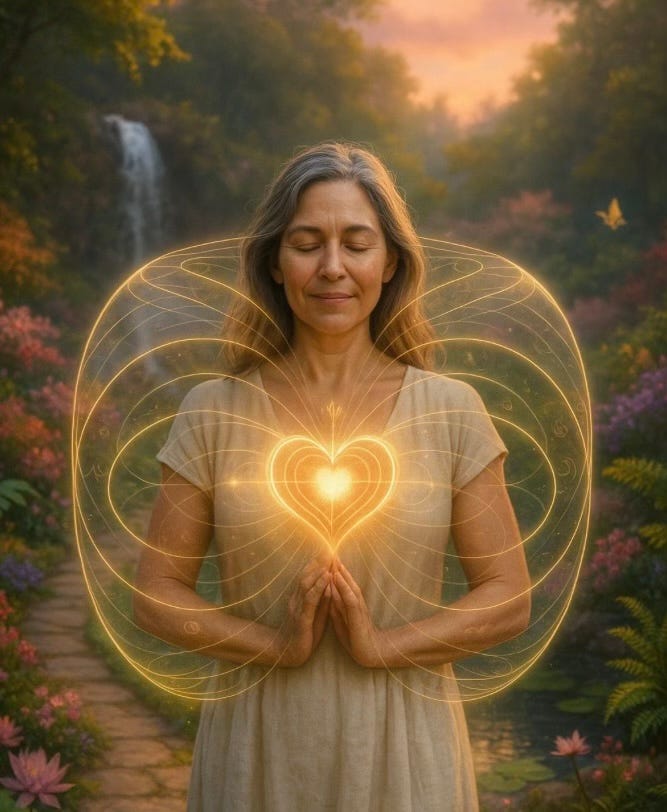
The human heart is far more than a cardiovascular pump or the place from which we love, or the center of our heartache. Its electrical activity actually produces the strongest biomagnetic signal of the body, measurable with sensitive instruments known as magnetometers. In clinical research this signal is captured as the magnetocardiogram.
Current biomedical instruments detect the heart’s magnetic field at short distances from the body, and there is promising research in quantum sensors that extend the range and practicality of measurement to further distances.
You may have also heard that the heart’s field reaches extraordinary distances, collapsing space and time, to be felt by someone in your inner circle living across the world. Spiritual lineages often speak in metaphors of boundless radiance and the ability for the heart energy to change lives across the world, and those images can be profoundly inspiring, as can the experience itself.
One instrument many of us are familiar with is the electrocardiogram (EKG/ECG). An EKG records the heart’s electrical activity from sensors on the skin, creating a waveform that reveals rate, rhythm, and conduction patterns. Clinicians read these patterns to identify issues such as arrhythmias, ischemia, electrolyte disturbances, or structural strain, and to also monitor how treatments are working.
The same signal can be analyzed for heart rate variability, which provides a window into the autonomic nervous system assessing balance and stress resilience. When stress is high and recovery is low, variability often narrows; when “stress management” techniques such as breathwork, meditation, exercise, and improved restorative sleep are practiced, variability tends to widen, reflecting a calmer, more adaptable nervous system and a healthier heart. In practice, EKG-guided insight pairs well with lifestyle and meditative practices to support both heart health and everyday steadiness.
Furthermore, it is well established that heart rate variability (HRV) is demonstrative of the flexibility of the autonomic nervous system (both parasympathetic and sympathetic), and it can be trained and strengthened through regular physical and meditative practice.
Qigong belongs to a family of “meditative movement” practices that consistently improve heart-rate variability, which is linked to vagal tone, stress resilience, and emotional regulation. In recent research on Tai Chi and Qigong, investigators report shifts toward parasympathetic balance and healthier variability patterns. These shifts are not merely technical, they map onto what practitioners feel as calm alertness, steadier moods, and a deeper ease in the body.
You’ve read some of my ideas on the Doing-Dosing Cortisol Loop as well as how perimenopause may be exacerbated by an inactive parasympathetic nervous system and an overactive, or worse yet, burned out sympathetic nervous system. I’m ever more convinced of these hypotheses as my understanding of Qigong and ancient wisdom grows deeper, but I digress. Let’s continue as I have more science to share.
There is a story about cellular aging that takes us beyond the science of the heart, but to the science of our DNA and our longevity. In 2009, the Nobel Prize in Physiology or Medicine honored Elizabeth Blackburn, Carol Greider, and Jack Szostak for discovering how telomeres protect chromosomes and how the enzyme telomerase maintains them. That work did not study Qigong directly, but it opened a door to understanding how stress, lifestyle, and contemplative practices might influence biological aging.
Subsequent small studies followed people engaging in comprehensive lifestyle programs that included “stress management” and contemplative practices.
Researchers observed increased telomerase activity over a few months and even lengthening of telomeres over several years; which some consider to be “reverse aging”. Separate research in intensive meditation settings linked positive psychological changes with higher telomerase activity. The evidence is still emerging and not a prescription to “cure aging,” but it suggests that what we do with our attention, breath, and daily choices can reach all the way into the nucleus of our cells, into our very DNA, and our longevity.
That’s powerful.
When we practice Qigong, we quiet the sympathetic urgency that keeps the body in vigilance, in doing, in moving from one place to the other. Randomized trials of Tai Chi, a martial form of Qigong, have demonstrated reductions in circulating inflammatory markers such as interleukin-6 among older adults with elevated levels, and gene-expression studies point to down-regulation of NF-κB–related inflammatory pathways.
This means there is a reduction in the inflammatory response that can get activated by an overly stimulated sympathetic nervous system, which can also cause havoc on the heart!
These shifts echo what practitioners often report. Sleep deepens, the mind settles, the body recovers its rhythm, and mood becomes more buoyant, intentions become more clear, and a joy of life rises from within as the confidence in the essence of spirit is present.
For women navigating perimenopause and post-menopause, these changes matter. Hormonal transitions can amplify sleep disruption, mood variability, and vasomotor symptoms. Carefully designed studies with postmenopausal women suggest that Qigong programs improve the severity of menopausal symptoms and enhance health-related quality of life. Other trials show improvements in anxiety, depression, and sleep quality. These are gentle, accessible practices that meet the body where it is and help it remember coherence of mind, body, heart and spirit.
Finding Peace & Trust in Wu Wei
All of this brings us back to the heart center as an experiential bridge between the physical and the spiritual. In Qigong the physical body becomes less obstructed, breath moves without strain, and attention grows spacious. When that happens the heart begins to lead, not as sentimentality, but as an integrated intelligence uniting spiritual with physical.
The heart’s rhythm entrains the brain’s rhythms, posture aligns with intention, and the mind stops arguing with the moment. From this place, intuitive messages become practical guidance, and signs and symbols appear like red and green lights to help you discern.
The body recognizes what food, what movement, and what pace of life serves it best: it comes to Know Thyself. The mind recognizes which thoughts are true enough to live by. Speech grows kinder and cleaner because it comes from coherence rather than reactivity, or more simply, from the mind alone.
Practice, life practice, is a Temple Path cobblestone of life. The more you practice the more you get familiar with what feels right for yourself. In Qigong, you first learn to gather the energy. using the power of breath, your attention, and simple postures. Your practice continues to cultivate energy, circulate it and then ultimately transmit the energy.
Transmission is not something mystical you force, or have to work on. It is what happens when a coherent field of energy meets the world. A coherence of mind, body, heart and spirit, accepting your very nature and trusting in your very nature. The greater the coherence the further the distance of your magnetic field is detected by the magnetometers - it all ties together!
You will see casual shifts in your day life. People you’ve never met before will feel relaxed around you, their shoulders drop, and they seem to breathe a little deeper, without knowing why. You become, in the best way, contagious, and soon enough people just begin to approach you, even for a simple hello. A moth to a flame phenomenon.
There is a beautiful paradox here. The more we practice expanding from the heart, from living the essence of our spirit, the less we conjure reality to be in our favor from our mental perspective, and the more we receive and open ourselves to our deeper alignment, receiving the flow of life. And the more we let go, the less stress we endure, and the less stress we endure, the more active our parasympathetic nervous system, and the more we engage in the flow.
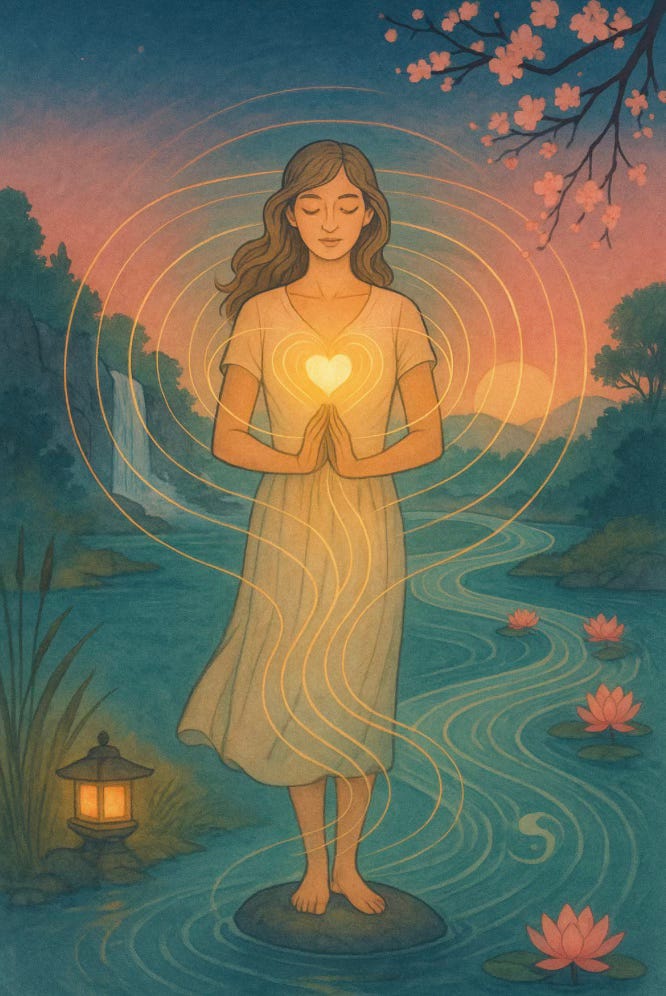
You begin to recognize that there is a current already flowing beneath your plans. The Tao Te Ching calls this current the Way, the Tao. When your intention is aligned with that current, and you are in the flow of Tao, you experience Wu Wei. Wu Wei is the art of non-doing, or effortless action, or effortless effort. It is not passive, not inert, but rather that state of “going with the flow”. You still make decisions, and you take action towards your intentions, however, the work itself feels like listening and responding, versus conjuring and pursuing.
In the state of Wu Wei, you become more inviting of life’s blessings, and trusting in receiving the natural flow of life, and in this state of being, the parasympathetic nervous system is activated and the sympathetic nervous system is in active balance, resulting in what I like to call moments of Active Rest (in the West we call it “stress management”.
Either way, life’s orchestration becomes more obvious, and the sense of having to push everything uphill softens. The paradox? Well, you have to begin to trust in an alternative approach to life, which in and of itself can feel stressful, over-activating the sympathetic nervous system.
Often times we would rather continuing trusting in what we’ve been doing rather than trust in something new, let alone something that asks us to release our thoughts and let our heart guide the way. Only we know within that something needs to give.
The beauty of Qigong practice is that it calms the nervous system while allowing us time to get familiar with opening the heart and with living from the essence of spirit.
Bridging Science & Spirituality of the Heart
Practices that raise heart-rate variability and settle inflammation also tend to improve cognitive flexibility and emotional regulation. In everyday terms, that means we notice opportunities that fit, we say no to what does not, and we recover quickly when life surprises us. The spiritual language says the same thing with different poetry. When the heart leads, the path reveals itself.
Daily Qigong is not a heroic undertaking. Thirty minutes in the morning can set the tone for hours if not the entire day. As you become familiar with the movements, you can practice for a few quiet breaths between meetings, at the kitchen sink, or before sleep. Soon your lifestyle includes Qigong throughout the day as simply breath and movement.
Over weeks, and especially around the 100 day mark, the effects begin to compound. The nervous system becomes more balanced and you begin to feel energy in your day, inflammation markers tend to move in healthier directions, and you notice you’re more mentally clear and focused.
Over years, you notice you no longer live from stress as a default driving force, but rather a calmness and grounded-ness that helps you respond to life. The mind remains capable, yet it no longer needs to dominate. The heart is now in conversation with the mind, and the spirit is no longer relegated to weekend or annual retreats.
The spirit is present in moments that may have previously caused frustration: the grocery store line, the decisions you make about your work, the red-taillight traffic jams. You begin to magnetize a reality that fits your deepest integrity, not because the universe is delivering wish lists, but because you are coherent enough to recognize, discern and cultivate what belongs and what doesn’t. The Law of Alignment.
During perimenopause and post-menopause, shifts in estrogen, sleep, and stress responsiveness can narrow the “window” of regulation. Gentle coherence practices such as Qigong forms, breath work and heart-centered attention have the ability to expand that window. They support vagal tone, improve HRV, and help the brain-heart loop move from vigilance to spacious presence. That presence is what many are sensing when they say, “Your energy changes the room.” It’s the lived, embodied side of the heart’s field, and somehow subtle, measurable and undeniably felt.
The heart center is not a metaphor you need to believe in. It is a place you can feel when you give it room. Qigong gives it room. Spirit gives it voice. Science helps us put words and comprehension to what’s happening and encourages humility as we continue to explore. The Nobel work on telomeres reminds us that what seems intangible can become measurable. The trials on heart-rate variability and inflammation tell us that gentle practice changes how we age and how we heal. The ancient teachings remind us that the deepest medicine is alignment.
When the heart leads, there is less noise. When the body is anchored in the spirit, there is less fear. When the mind serves the heart, there is more clarity. Qigong is a powerful pathway into this light of alignment. Practice, and let the light do what light does, illuminate the path.
Find your practice and trust the process. In person practice is the most powerful and I encourage you to look in your area for a place of practice. In the meantime, all are welcomed to begin a practice at The MenoJourney Sanctuary, MenoQigong. This offering is intended to provide you with a resource for self exploration in the art of Qigong. It has certainly been pivotal in changing my own MenoJourney, and yes, I believe all women would benefit from this practice.
As always, pair practice with appropriate medical care. Qigong is a very gentle practice and supports healing and alignment, and it sits beautifully alongside evidence-based treatments and the wisdom of your own body.
LabNotes on the Science if you care to read more in depth:
In studies with postmenopausal women, Qigong programs improved the severity of menopausal symptoms and enhanced sleep quality, anxiety, depression, and health-related quality of life. PubMedLippincott Journals
The 2009 Nobel Prize in Physiology or Medicine recognized the discovery of how telomeres protect chromosomes and how telomerase maintains them. This foundational work inspired later clinical studies exploring how lifestyle and contemplative practices relate to telomere biology. NobelPrize.org
Lifestyle programs that included “stress-management” and contemplative practices were associated with increased telomerase activity over three months and with telomere lengthening over five years in small cohorts. Intensive meditation training has also been linked with higher telomerase activity. These findings are promising and still developing. The Lancet+1PubMed
The heart’s magnetic field is the largest biomagnetic signal of the body and is detectable with sensitive instruments near the chest. Heart-rate variability reflects autonomic flexibility and can be favorably influenced by Tai Chi and Qigong. PMC+1Lippincott Journals
Trials in older adults show Tai Chi can reduce inflammatory markers such as interleukin-6 and down-regulate pro-inflammatory gene expression. Reviews of mind-body practices, including Qigong, report beneficial shifts across immune and inflammatory outcomes. PubMedeScholarshipPLOS
You are your best alchemist!
In Love, Light, Peace and Joy,
Dr. Ellie
Dr. Ellie Corigliano, PhD | AUG 17, 2025
Share this blog post


 OfferingTree