The Inner Journey Sanctuary
The Quiet Architecture of Tai Chi
Arcanium Alchemy | DEC 18, 2025
tai chi
qigong
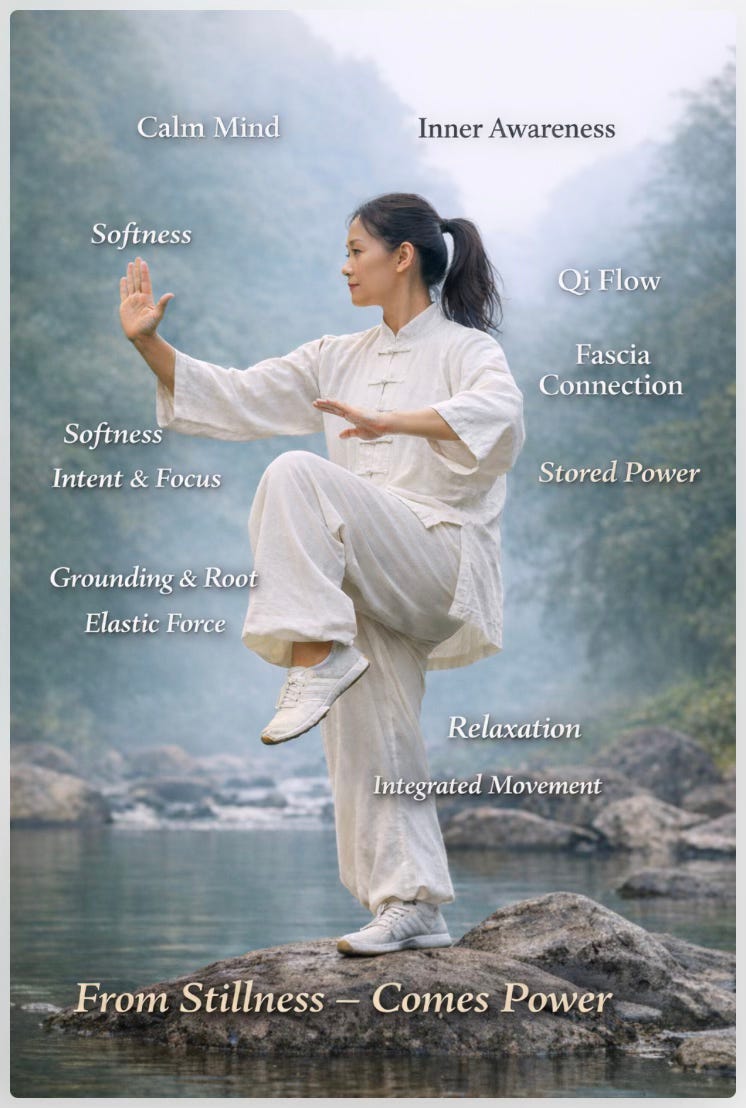
Wang Zongyue, Taijiquan Treatise:
“The mind leads the qi.
The qi leads the body.
When the mind is still, qi can gather.
When qi gathers, the body becomes light and agile.”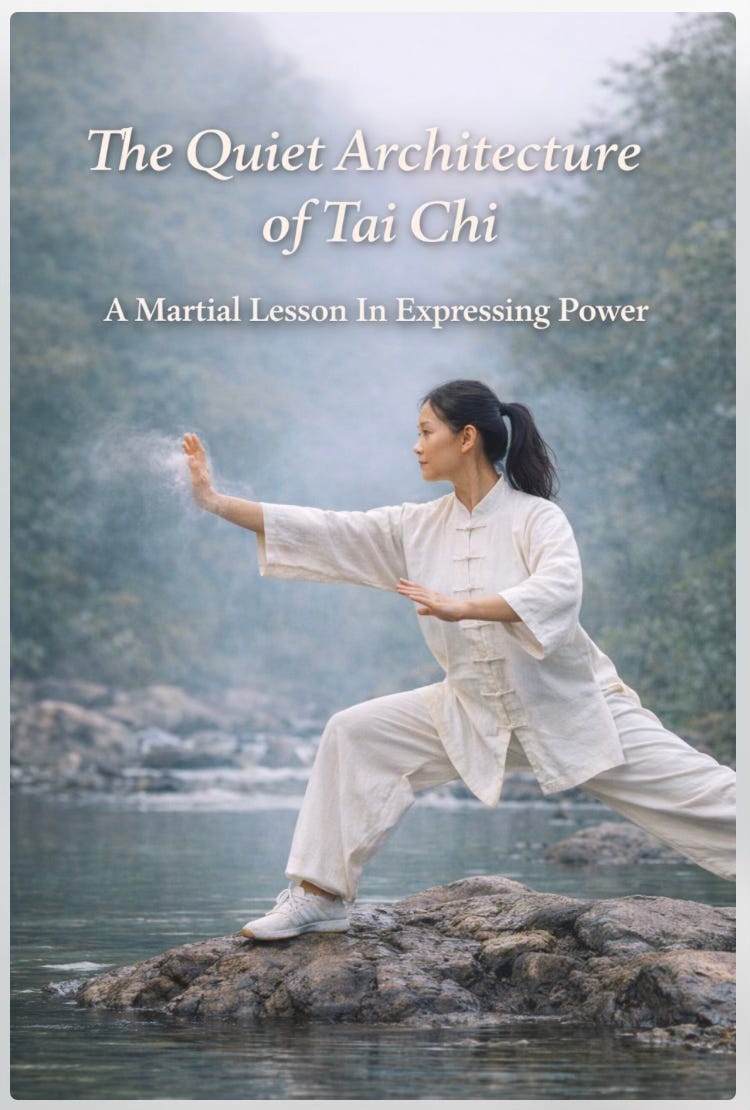
Over the past several weeks I stepped into a quieter rhythm, immersing myself in my own affairs and Tai Chi training, giving my body and mind space to settle before the new year.
Much of my writing in the last year has centered on women’s health, particularly the changing physiology of midlife, and the profound transformation that unfolds when we understand hormones, the nervous system, and lifestyle rhythms through a more integrative lens.
This Substack is reader-supported. To receive new posts and support my work, consider becoming a free or paid subscriber.
While this last year has been a deep exploration into the biology of perimenopause and menopause, the emotional landscape that accompanies it, and the ways movement, breath, and presence can restore coherence to a system under strain, my focus has been on helping women navigate this threshold with clarity and compassion with the roots of that work reaching into the internal arts of Tai Chi and Qigong.
But the internal arts themselves remain beautifully universal, albeit initiating MenoQigong practice for women, I have no bias on the teachings themselves for all of humanity.
Tai Chi and Qigong sit beneath all of my recent work like a quiet foundation, reminding me that before hormones, before diagnostics, before lifestyle prescriptions or modern frameworks, there is a deeper rhythm that belongs to every human body, to human existence.
These practices are genderless and timeless. They speak directly to our physiology, our emotional centers, and the subtle intelligence that underlies both healing and vitality. Whether a person is navigating the complexities of perimenopause, rebuilding after illness, or simply seeking steadiness in the pace of daily life, the internal arts offer a way forward. They restructure us from the inside outward, without hurry and without force, and they invite us to remember what wellness feels like at the most elemental level.
I have learned through teaching MenoQigong, and through studying across different lineages and philosophies, that class structure is often overlooked by student practitioners. Many assume it is a matter of convenience or tradition, or casual habit, or of little consequence, not realizing that the sequence of a class mirrors internal physiology through which the practice does its restorative work.
In a recent experience in my own Master’s school of advanced Tai Chi training a suggestion was posed to change our class structure to be more like a yoga class. Conversations of sincere debate ensued about tradition versus innovation, personal preference versus yogic practices and taking on a western culture of expressing high energy early and then slow energy to close class.
Admittedly, yoga and I do not know each other deeply, even though I have completed some yogic training. I hold genuine respect for its breadth and intentions, and I reference it here only through the suggestion from a fellow practitioner that our Tai Chi class structure be reshaped to resemble a yoga class that he is familiar with.
There is a valuable lesson here. I will share here the wisdom I have learned from Tai Chi, both empirically from practice and traditional teachings I have read thus far, and from modern medical science.
I invite you to take a moment and join me as we explore the quiet but powerful architecture that makes Tai Chi what it is. A tradition that I also plan to uphold as I continue to advance in my practice and my own school of teaching the art.
Grab a journal, a pen, a hot cup of tea, and join me for a read.
Entering the Landscape of Tai Chi
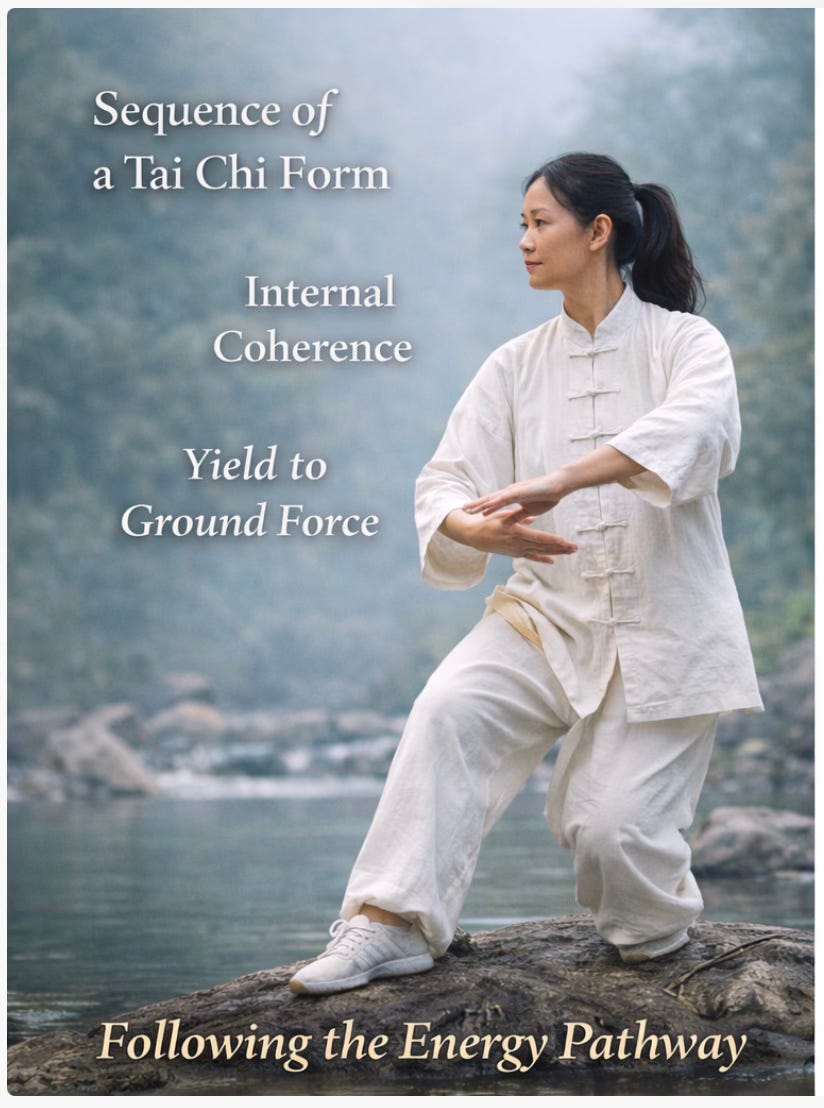
Tai Chi is often introduced as slow, gentle movement. Yet anyone who has stepped inside its living terrain knows how quickly that description dissolves. Beneath the surface lies a multilayered architecture that reorganizes the human system from the inside out.
There is an integration of breath, intention, connective tissue expansion, muscle release, neural rhythm, emotional tone, cardiovascular coherence, on and on, as well as the subtler layers of awareness that participate in this reordering.
Tai Chi is not merely a collection of forms and energies. It is truly internal medicine, natural medicine of healing prowess with longevity cultivation, beyond a subtle martial art capable of powerful expression. What allows all of this to emerge is not simply the forms themselves but the structure through which the practice is taught.
The structure of a Tai Chi class is part of the medicine.
Class structure itself holds traditional wisdom that has withheld the test of time, regardless of the family lineage from which the practice derived.
Why Class Structure Matters
In traditional schools, the order of a class is intentional. It mirrors the internal progression through which the practitioner shifts from cognitive attention, to somatic awareness, to energetic coherence. It sets the tone, the physiological rhythm, and the emotional environment for all forms and energies to be practiced.
Class structure itself is not administrative or an arbitrary preference, it is foundational. It is the very teacher behind the actual teacher.
Recently, in the school where I do my advanced training, a well-intentioned suggestion arose: begin class with the strongest expressions of movement, including the issuing of force known as ‘fa jin’, and only later descend into slower, quieter forms.
The suggestion seems harmless: if students arrive with energy, why not use it in the beginning of class?
But this suggestion, in my opinion, misunderstands the architecture and deep wisdom of Tai Chi practice.
There is a moment in internal practice when movement becomes more than movement. The breath deepens, the mind descends, and the subtle intelligence of the body emerges like a long-forgotten companion. Tai Chi was designed to meet us precisely in that moment, but it can only do so when we honor the sequence of effort that awakens it.
The Classical Learning Arc
Traditional texts often describe a three-stage progression that every practitioner must pass through.
In the beginning, the mind is occupied with learning the choreography. This is the cognitive phase, where attention is outward and the form is still unfamiliar. Neuroscience now shows that this phase strengthens explicit motor learning pathways in the brain.
In the second stage, once the sequence becomes familiar, awareness begins to sink into the body. Breath and attention weave together. Movements soften and deepen. The practitioner feels weight, spirals, rotation, and quiet internal currents. This corresponds to a shift into implicit motor learning, where somatic intelligence begins to guide the form. The mind has come to be more relaxed with curiosity and trust coming into the body and subtler energies of internal wisdom.
The third stage is where the art becomes truly alive. The mind quiets. The spirit becomes perceptible. The classical instruction that “the mind leads the qi and the qi leads the body” describes this beautifully. Modern somatic science would say that interoception strengthens, the autonomic nervous system regulates, and fascial continuity becomes the primary pathway of force transmission. This is the phase of moving stillness, of active rest, of meditative power, of transformational healing, of releasing and transmitting power to another.
Class structure exists to support this journey, irrespective of the level of the practitioner. For even the advanced student who knows the choreography, must still enter the sanctuary or temple and allow the mind to quiet, the inner body wisdom to emerge, and the qi to circulate with proper intention.
Why a Class Begins Slowly
Traditional teachers begin with stillness or slow preparatory movement because this is where the nervous system transitions from external demands to internal coherence. The practitioner has the opportunity to slow the heart rate, to deepen the breath, to warm and hydrate the fascia, to stabilize emotions, to draw on one’s presence and drop their attention into the body, mind, heart and spirit.
This is where the practitioner arrives.
It is often mistaken for warm-up, but it is internal preparation. It allows every student, regardless of the state in which they entered the room, to reconnect with their own sensory ground.
Health research affirms these effects. Studies from the Cleveland Clinic and the National Center for Complementary and Integrative Health show that Tai Chi supports cardiovascular stability, reduces inflammatory markers, improves balance and proprioception, enhances mood, and strengthens cognitive function. The beginning of class sets the physiological conditions for these benefits to emerge and prepare the body for coherence and suppleness that holds much power.
Cultivation and Continuity
Once coherence forms, the movements of the form become a medium for deeper integration. Breath synchronizes with motion. The center begins to lead. Elastic continuity in the fascia replaces muscular effort. The practitioner feels themselves move as one organism rather than a collection of parts.
This is the true cultivation phase. In classical language, this is where qi is gathered and circulated.
Li Yi:
"They guide the qi so that it becomes harmonious, and guide the body so that it becomes supple."
In medical language, it is where neuromyofascial communication strengthens and the autonomic nervous system reaches a balanced state.
This middle portion of class is where the transformation happens. If the practitioners remains in this state, where they are cultivating the deeper understanding of biomechanics, now they can move into the next phase of the class.
This next phase is where one can move into the ability to release the power of this energy. This power is known as Fa Jin.
Short Explanation of Fa Jin for Non-Practitioners
Fa jin is the term traditionally used in Tai Chi to describe the issuing of force, yet it is not force in the way most people imagine. It is not a punch, a strike, or an exertion of muscular strength. Fa jin is the rapid release of internal power that has been gathered, organized, and stored within the body through soft, continuous movement.
When the body is relaxed, aligned, and guided by breath, the connective tissues behave like an elastic network. They can receive force, redirect it, or release it in a sudden wave that travels from the ground, through the center, and outward through the limbs.
To the observer, fa jin may appear like a small, simple motion, but the power comes from inside rather than from effort. It is the expression of coherence. When the mind is quiet, the breath steady, the joints open, and the fascia engaged as one unified system, the body becomes capable of generating power without strain.
Masters caution that fa jin should never be overused or performed from a tense or unprepared state, because when the internal coherence is not present, the movement becomes mere muscular force rather than true internal strength.
Fa jin is therefore not simply an expression of physical ability. It is a measure of internal organization and the culmination of a sequence that begins in stillness, grows through softness, and returns to stillness again.
When and How to Use Fa Jin
Fa jin belongs only after the body has unified and the mind has quieted. It is not force in the ordinary sense. It is the rapid release of stored elastic energy transmitted through an integrated system.
When performed too early, before coherence has formed, the practitioner falls back into bracing patterns. Breath becomes shallow. The sympathetic nervous system activates. Muscular contraction replaces internal connection. The shape of the movement might look correct, but the inner method collapses.
This is why Fa Jin practices are typically reserved for more advanced students who hav developed the skills of coherence.
Traditional teachers warn against overuse of fa jin without stillness. They understood that the body produces authentic internal force only after the qi has been gathered and the mind has settled.
Modern movement science agrees. Introducing intensity before regulation disrupts motor learning, reinforces stress pathways, and prevents the fascia from entering the elastic, springlike state that makes Tai Chi power possible.
Class as Martial Foundation
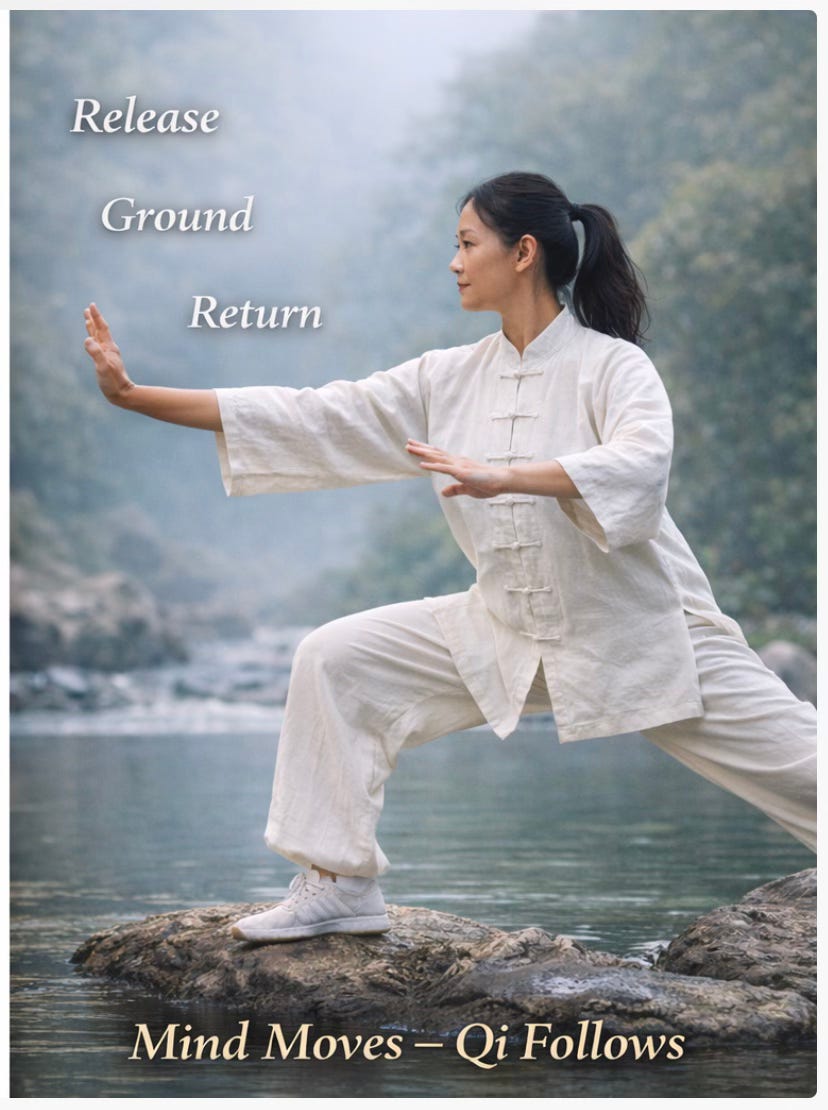
Tai Chi is a martial art. Within a single form, a practitioner expresses peng, lu, ji, an, cai, lie, zhou, and kao. These energies require sensitivity, timing, and structural integrity that cannot be rushed.
When class begins with regulation and coherence, the martial qualities of the art can emerge without damage to the body. The practitioner learns to redirect force rather than oppose it, to move from the center rather than the limbs, and to access power without sacrificing softness.
When a class begins with intensity, these subtle energies may become distorted. The practitioner may confuse effort instead of experiencing elasticity.
Martial arts based on internal power do not begin at the peak. They begin at the root.
Why Class Ends with Stillness
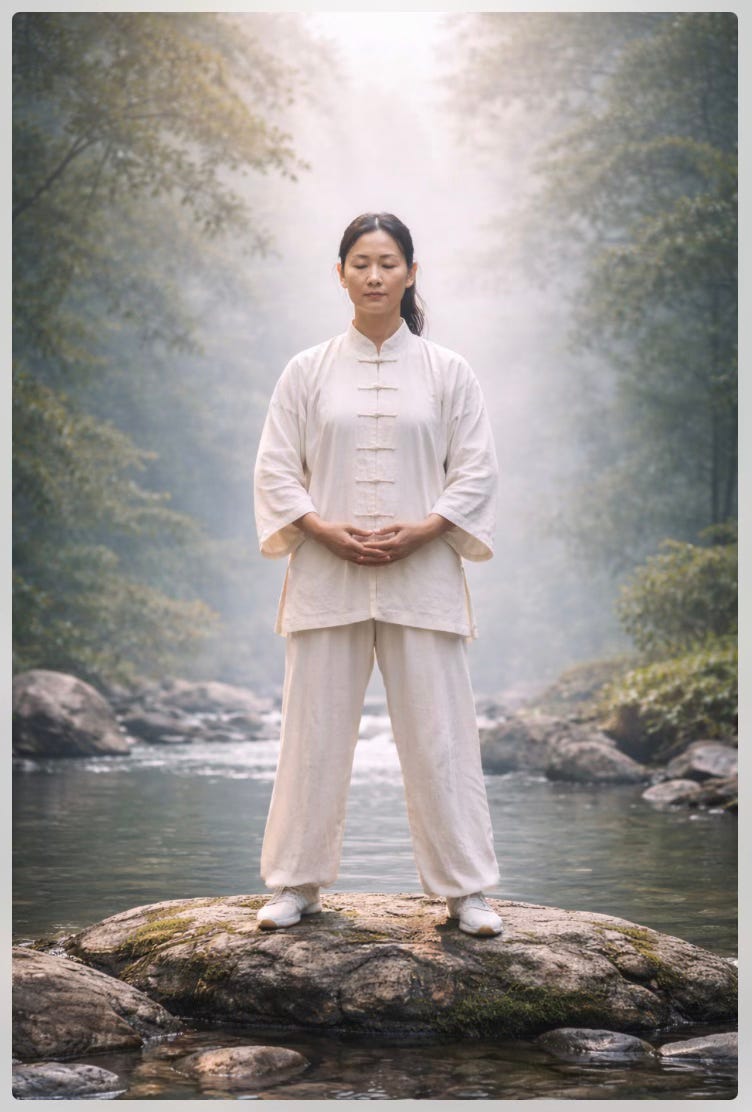
The closing portion of class is where the system integrates everything it has learned. Slow forms, quiet standing, or gentle closing postures allow the breath to settle. The internal force sinks into the lower dantian. In classical language, the gates close and the practice is sealed.
This is essential for longevity. This is essential for the healing nature of the practice to continue far after the practice is over.
Modern research shows that the end of class supports neurochemical recovery, consolidates neuromuscular learning, and protects hormonal rhythms involved in energy, sleep, and metabolic balance. Without this closing phase, the practitioner leaves stimulated rather than nourished, and the deeper benefits of Tai Chi remain unfulfilled.
Ending softly does not diminish the power of the practice. It preserves it.
The Structure Is the Medicine
The sequence of a Tai Chi class is not ornamental. It is essential. Regulation leads to integration. Integration leads to expression. Expression must return to stillness. This is how the body heals, how the mind clarifies, how the spirit emerges, and how authentic internal power develops. This internal power can be used for healing, for exertion, for longevity.
When class structure is respected, Tai Chi becomes a pathway for resilience, emotional steadiness, and deep presence. When the structure is altered, the outer form remains but the inner transformation may become much harder to access.
Tai Chi opens the fountain within only when the pathway into that fountain is allowed to do its quiet work.
This is the ability of moving stillness, but first one must come to know the state of moving stillness itself.
Much love,
Dr. Ellie
Dr. Ellie Corigliano, PhD
Founder of Arcanium Alchemy and creator of MenoQigong
Exploring the science, soul, and sovereignty of midlife vitality

References
Cleveland Clinic. Tai Chi and the Health Benefits of Mindful Movement
National Center for Complementary and Integrative Health. Tai Chi: What You Need to Know
Wang, C. et al. Tai Chi for knee osteoarthritis. Arthritis Care and Research
Yeh, G. et al. Tai Chi exercise in patients with chronic heart failure. American Journal of Medicine
Wayne, P. and Kaptchuk, T. The challenges of Tai Chi research. Journal of Alternative and Complementary Medicine
Scientific Reports, Nature Portfolio. Tai Chi, neural regulation, and motor control
Classical Tai Chi sources including the Taijiquan Treatise and the writings of Chen Xin
Arcanium Alchemy | DEC 18, 2025
Share this blog post


 OfferingTree